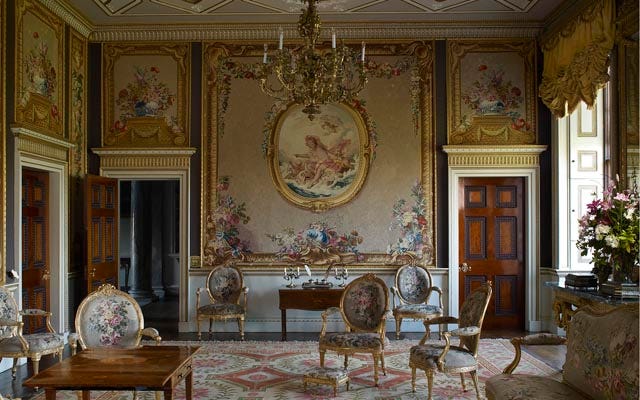
Walk through an old European house and almost every surface demands attention.
Carved wooden furniture. Heavy curtains. Patterned rugs. Porcelain figures lined across shelves. Framed paintings layered across the walls. Chandeliers, fireplaces, moldings, engraved cabinets. Sometimes even the ceiling refuses to remain empty.
Then look at the ideal modern home.
Smooth cabinets. Bare walls. Clean lines. Hidden storage. A few carefully selected objects placed far enough apart to make the room feel almost untouched.
We usually explain this difference through taste. One generation liked ornament; another discovered minimalism.
But looking at those old rooms, I started wondering something much less glamorous:
Who cleaned all of it?
And once that question is asked, minimalism begins to look less like a purely aesthetic revolution and more like something connected to a much larger social one.
Our homes did not become easier to maintain by accident. They changed alongside the people expected to maintain them.
Beautiful, because someone else was cleaning it
An ornate nineteenth-century interior was not simply expensive to purchase.
It was expensive to maintain.
Every additional object created another surface. Every carving created another place for dust to settle. Rugs had to be cleaned. Metal polished. Fires maintained. Curtains washed. Furniture moved. Glass wiped. Decorative objects individually dusted.
Historical household manuals make this labor remarkably visible. Domestic servants were expected to clean windows and mirrors, sweep stairs, maintain fireplaces, polish surfaces, and carefully dust rooms filled with ornaments. In Britain, domestic service remained one of the largest sources of employment for women well into the twentieth century.
The elaborate home worked because an enormous amount of human labor existed behind it.
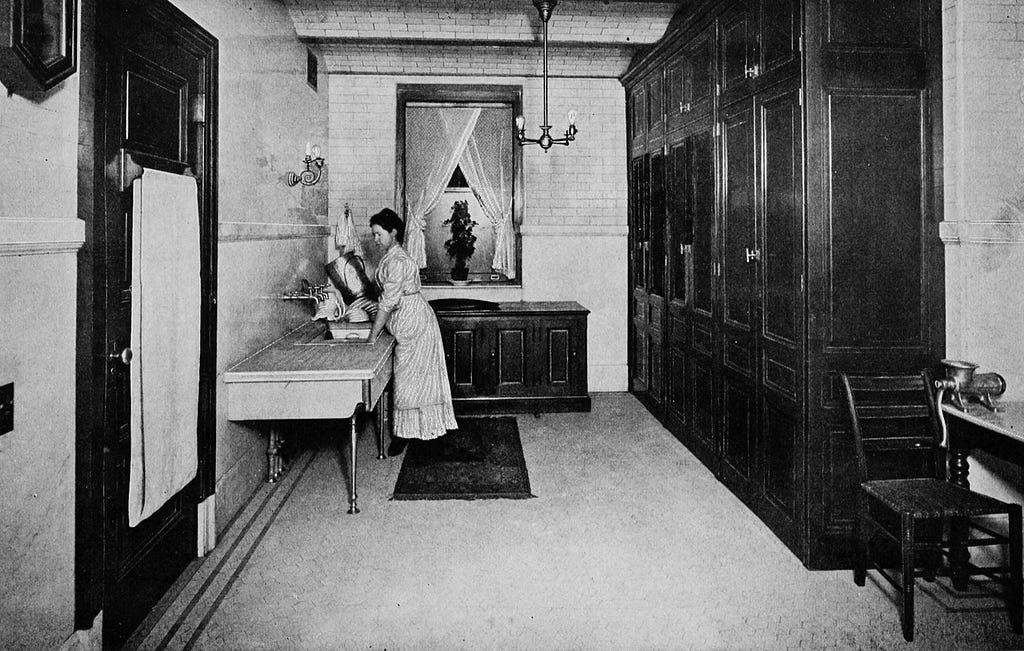
That labor tends to disappear when we admire historical interiors today.
We see the chandelier.
We do not see the person cleaning it.
We see polished wood, elaborate carpets, silverware, fireplaces, and rows of decorative objects as evidence of wealth. But perhaps the deeper display of wealth was never the object itself.
It was the ability to employ someone else to maintain it.
An ornate house quietly announced that its owners had enough money, status, and labor available to support objects that required constant attention.
In that sense, decoration was not only aesthetic.
It was economic.
Then the labor underneath the house began to disappear
During the twentieth century, the structure of domestic service changed dramatically.
Women had increasing access to jobs outside private homes. Retail, clerical work, factories, and other occupations offered alternatives to residential service. Social expectations changed as well. Living inside another family’s home, working long hours, and occupying a clearly subordinate position became less attractive when other options existed.
In Canada, research on domestic servants between 1871 and 1931 found that demographic change and shifting worker expectations reduced the supply of domestic labor. When employers struggled to replace those workers, they increasingly turned toward household technology instead.
Britain followed a similar transformation. After the Second World War, newspapers and designers became fascinated by a new problem: the “servant-less home.”
The phrase itself says a lot.
The middle-class household had been built around the assumption that somebody would perform its repetitive physical work. Once that person disappeared, the home had to change.
And it did.
Vacuum cleaners replaced some sweeping. Washing machines replaced some hand washing. Refrigerators changed food storage. New kitchen equipment reduced certain forms of physical labor.
But technology was only part of the answer.
The interior itself became easier to clean.
Contemporary discussions of the servant-less home explicitly promoted uncluttered furnishings because they made cleaning faster.
Suddenly, the empty surface was not merely fashionable.
It was useful.
Maybe “clean lines” were actually easier lines
This connection had already begun appearing much earlier.
In the nineteenth century, British design reformers such as Charles Eastlake criticized heavily carved furniture partly because it trapped dust and dirt. He advocated simpler forms that could be cleaned more easily. Designer E.W. Godwin similarly rejected excessive carving and designed furniture that could be moved more easily for cleaning.
That detail changes the way minimalism can be understood.
We often talk about simplified design as though designers suddenly discovered a more sophisticated visual language.
Perhaps sometimes they were also simply tired of dust.
The movement from carved to smooth, crowded to open, exposed to concealed and decorative to functional was not caused by cleaning alone. Modernism emerged from industrialization, new materials, changing ideas about hygiene, mass production, technology, artistic rebellion and many other forces.
But domestic labor belongs in that history too.
Because every design decision creates work.
A groove has to be cleaned.
A rug has to be moved.
A curtain has to be washed.
A shelf full of objects has to be dusted object by object.
Design determines not only what a home looks like.
It determines what someone has to do to keep it looking that way.
The kitchen may show the shift most clearly
Nowhere is this relationship between labor and design more obvious than the modern kitchen.
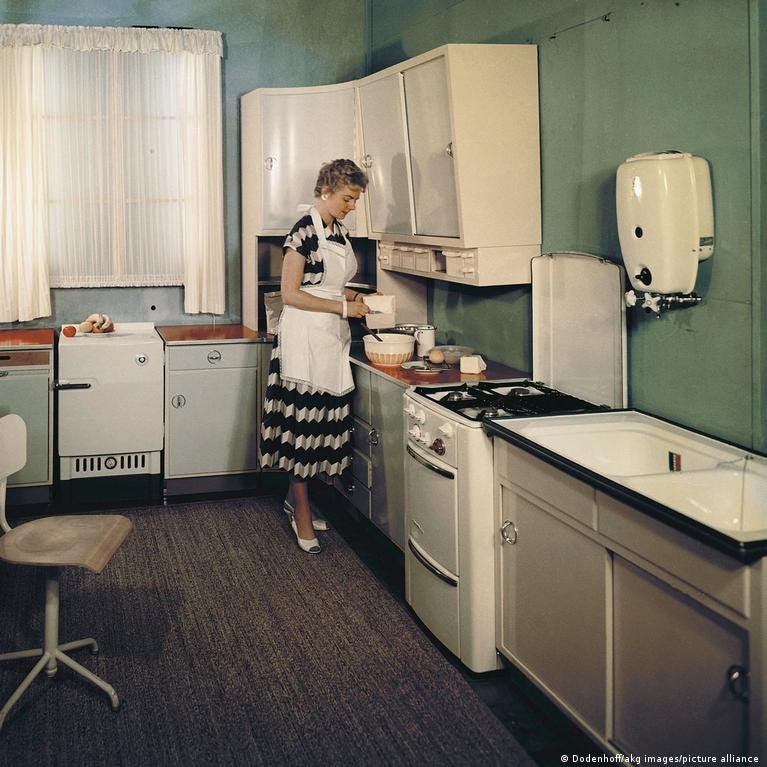
The Frankfurt Kitchen, designed by Margarete Schütte-Lihotzky in 1926–27, is often treated as a landmark of modern design. Its compact layout organized storage, preparation, washing, and cooking around efficiency.
But its importance was not simply visual.
The kitchen was designed around movement.
Researchers studied how the person working inside it moved from one task to another. Cabinets, work surfaces, storage containers, lighting, an ironing board, and even waste disposal were positioned to reduce unnecessary steps and save labor.
Look at it now and it feels strangely familiar.
Built-in cabinets.
Continuous counters.
Objects stored away rather than scattered across the room.
Everything within reach.
The DNA of the modern kitchen is already there.
What looks to us like a clean aesthetic was also an attempt to solve a labor problem.
The house was being redesigned around a different assumption: the person living in it might also be the person doing the work.
That is not a small change.
It means architecture had to begin respecting time.
Minimalism did not just make houses look different
This is where I think the usual story of minimalism becomes incomplete.
We describe taste as though it develops separately from ordinary life.
Victorians liked ornament.
Modernists liked simplicity.
We like white walls.
But preferences do not develop in a vacuum.
What feels elegant is influenced by what is practical. What feels modern is influenced by technology. What feels excessive is influenced by how much time people have available to maintain it.
A room requiring several hours of weekly cleaning feels very different in a household with multiple servants than it does in a household where two adults both work full-time.
The same object can move from beautiful to irritating because the social structure surrounding it has changed.
Perhaps this explains part of the appeal of the modern cupboard.
Close the door and everything disappears.
Perhaps it explains the attraction of smooth surfaces.
Wipe once and move on.
Perhaps it explains why enormous collections of small decorative objects can now read as “clutter,” while an almost empty shelf can read as sophisticated.
Taste changes.
But so does the amount of labor a society is willing — or able — to spend maintaining taste.
There is one problem with this argument
Minimalism did not actually eliminate domestic labor.
Someone still cleans the glass.
Someone still wipes the white countertop.
Someone still vacuums beneath the carefully selected Scandinavian chair.
And the cleaner the aesthetic, the more obvious every fingerprint, crumb, and streak can become.
That creates a strange contradiction.
Minimalism sells an image of effortlessness while often requiring continuous effort to remain effortless.
Contemporary architecture can be particularly good at hiding this. An immaculate modern lobby appears naturally immaculate. A glass wall appears naturally transparent. A white stone floor appears naturally spotless.
But architecture does not clean itself.
Writing on domestic labor and architecture has pointed to exactly this invisibility: cleaners often work outside the hours when the people using a space are present, allowing pristine architecture to appear almost maintenance-free. Even celebrated modernist spaces depend on repeated human care to preserve their apparent simplicity.
So perhaps minimalism did not remove labor.
It changed our relationship to seeing it.
From displaying labor to hiding it
This may be the most interesting shift of all.
An aristocratic house filled with ornament openly demonstrated its capacity for maintenance.
Look at these carpets.
Look at this silver.
Look at these chandeliers.
Look at these rooms filled with things that somebody must constantly care for.
The labor itself remained socially subordinate, but the abundance it enabled was visible everywhere.
Contemporary luxury often communicates wealth differently.
Nothing appears difficult.
Storage disappears into walls. Appliances disappear behind cabinets. Wires vanish. Air conditioning arrives through nearly invisible vents. Surfaces stretch uninterrupted across entire rooms.
The visual language is not abundance.
It is frictionlessness.
The wealthy home no longer necessarily says, “Look how much we own.”
Increasingly, it says, “Look how effortlessly we live.”
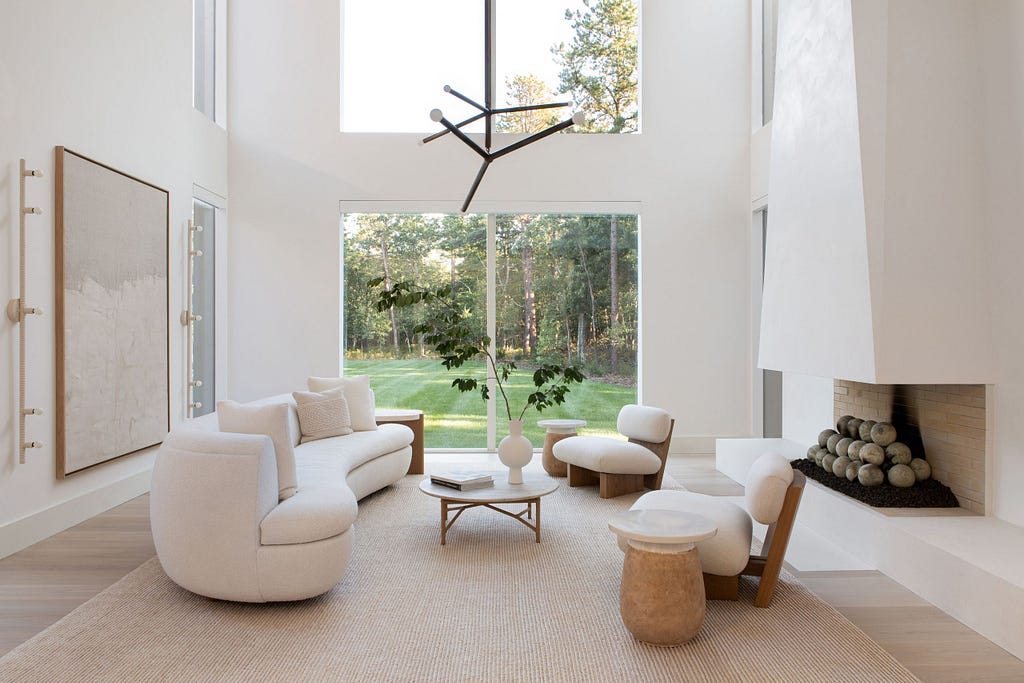
But effortlessness is often manufactured.
Someone designed the hidden storage.
Someone maintains the garden.
Someone cleans the glass.
Someone wipes the marble.
Someone resets the room so that it appears as though nobody has touched it.
The labor has not disappeared.
The design has simply become better at concealing it.
The aesthetics of who has time
None of this means people only like minimalism because they hate cleaning.
Aesthetic history is never that simple.
Modernism was philosophical, political and artistic. Industrial production changed what could be manufactured. New ideas about hygiene changed what people considered healthy. Smaller urban homes changed what could fit inside them. Economic conditions changed what people could afford.
But domestic labor deserves to sit beside those explanations rather than underneath them.
Because architecture is not experienced only by looking at it.
Someone has to live inside it.
And someone has to maintain it.
Every beautiful room quietly answers questions about time: How long does this take to clean? Who has that time? Is that work paid? Is it shared? Is it outsourced? Is it even noticed?
Once those questions enter the room, aesthetics stop being completely innocent.
Who cleaned the chandelier?
Maybe that is why I keep returning to the chandelier.
It is easy to look upward and admire it as evidence that people once cared more about craftsmanship, detail, or beauty.
Maybe they did.
But someone also climbed up there and cleaned it.
Probably repeatedly.
And that person was part of the architecture too, even if architectural history rarely places them in the photograph.
Perhaps our transition from ornament toward simplicity was not merely a story about people deciding that less looked better.
It was also a story about industrialization, women entering different forms of work, domestic servants becoming less available, appliances taking over certain tasks, homes becoming smaller, household labor changing hands, and designers confronting a simple reality:
someone still had to clean the room.
Minimalism did not arrive because society suddenly became tired of beauty.
Part of what changed was the economic system that made certain kinds of beauty easy to maintain.
That leaves us with a different way of looking at both old and new interiors.
The ornate home says: look at everything we can maintain.
The minimalist home says: look how little maintenance seems necessary.
Both statements can be illusions.
Because behind almost every supposedly effortless space is the same question architecture has never managed to escape:
Who is doing the work?